

JDM vs Domestic Market Fishing Gear: What Changes
Quick Summary
JDM vs domestic market fishing gear differs mainly in which models exist, how they are specified, and what the packaging includes. Reels can have different gear ratios, spool sizes and handle options, so compare listings closely before assuming two versions are interchangeable.
Japanese-market reels are often listed in metric with different model codes, so numbers may not match U.S. spec sheets.
Compare gear ratio and recommended line rating side by side before assuming two models are interchangeable.
Imported gear adds shipping, duties, brokerage and possible sales tax to the sticker price.
Confirm warranty scope and repair routes before buying, since imported gear may not qualify for a domestic warranty.
Table of Contents
Before we start: the source situation
Automated research turned up almost nothing verifiable for this topic, so this draft follows zero-fabrication rules: no percentages, no dollar figures, no named studies, no quotes. Where a price or spec would normally appear, the reader is pointed to the retailer's own listing. Pine State Tackle's own pricing was not supplied, so no brand prices are given either.
Last Updated: October 30, 2026
What JDM Means and Why It Matters to Bass Anglers
JDM stands for Japanese Domestic Market. It describes fishing tackle built and sold for anglers in Japan, which often differs from the version sold to U.S. anglers under the same brand name. Browse our Top Rated JDM Fishing Brands overview to see the best Japanese-market brands worth knowing. Understanding JDM vs domestic market fishing gear matters here, and
The gap usually shows up in three places: which models exist, how they are specified, and what the packaging and documentation include. A reel with the same name can have different gear ratios, spool sizes, or handle options depending on the market. For bass anglers, those details change how a lure feels on the retrieve and how far it casts.
Before buying, read the listing closely and compare it to the domestic version. Our overview of Japanese fishing tackle categories is a useful starting point if you are new to the market.
JDM Fishing Reels vs USDM: Specs, Gear Ratios and Line Capacity
Reels are where most JDM versus domestic comparisons begin, and the JDM vs domestic market fishing gear question usually starts with specs.
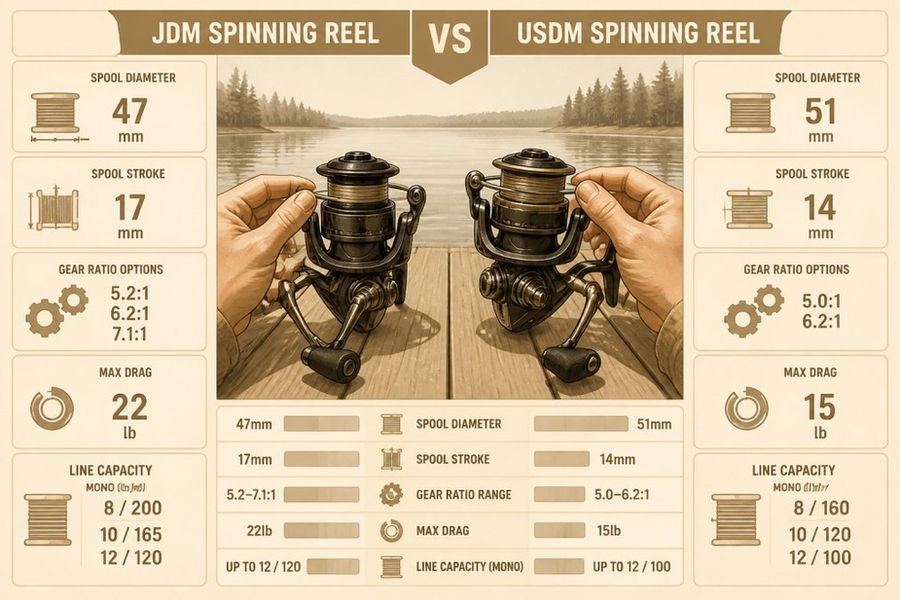
Japanese-market reels are often listed in metric and with different model codes, so the numbers do not always line up with what you see on a U.S. spec sheet.
!Two spinning reels side by side on a wooden dock beside a Maine lake, an angler's hands comparing the spool and handle
Line capacity matters as much as the rating on the box. A reel that holds a specific line weight in one market may list different capacities in another.
Watch out: a reel with a faster gear ratio is not automatically better for bass.
Rods, Lures and Handle Design: Side-by-Side Differences
Rods and lures follow the same pattern. The model name may match, but the action, length, or lure weight can differ between markets.
Handle choice affects comfort during long sessions and how the reel feels in your hand.
For lures, check the stated weight, length, and hook size.
Our guide to choosing fishing line for lure fishing can help you pair a new lure or rod with the right line.
Best for: anglers who already know their rod and reel setup and want a specific JDM lure or handle style.
Skip if: you prefer a fully domestic setup and do not want to deal with model codes and metric specs.
Total Landed Cost: JDM Tackle Import Costs and Pricing Examples
The price on a product page is only the first line of the receipt. A JDM reel or rod that looks cheaper than its domestic counterpart can land on your doorstep for more once every cost is counted.
The cost stack, in the order it hits you:
Item price in yen. Convert at the rate your card or payment processor actually applies, not the headline rate on a finance site. Card networks add a currency-conversion spread, typically a small percentage, and some cards add a foreign-transaction fee on top. A card with no foreign-transaction fee can save you real money on a large order.
International shipping. Carriers price by weight and dimensional size, so a rod tube costs far more to ship than a reel box of the same weight. Expect the shipping line to scale with length and girth, not just ounces.
Duties and import charges. Imported goods may be subject to duties and import charges, and the applicable rate depends on the product classification and country of origin. Check the current rate for the product before you assume a purchase is duty-free.
Customs brokerage and handling. If the carrier clears the package for you, a brokerage or disbursement fee often appears on the invoice. Some carriers bundle it; some bill it separately after delivery.
State and local sales tax. Online sellers may collect sales tax at checkout depending on nexus rules and your shipping address. Do not assume an overseas order escapes state tax.
Return shipping and restocking. If the item does not fit your rod or your hand, sending it back across the Pacific can cost more than the item is worth. Confirm the return window, who pays return freight, and whether a restocking fee applies before you order.
Warranty risk. A warranty that requires shipping the item back to the original market adds a future cost you cannot see at checkout. Price that risk in now (see the warranty section below).
How to build a side-by-side comparison:
Put the JDM item and the closest domestic equivalent in two columns.
Add every line above to the JDM column. Add only item price, tax, and domestic shipping to the domestic column.
Add a "warranty risk" line to the JDM column for the cost of a worst-case repair or replacement.
Compare the totals, not the sticker prices.
Fixed shipping and handling can make a single small item expensive to import, while multi-item orders spread those costs across several pieces. Pine State Tackle offers free domestic shipping on orders of $99 or more, so compare the delivered total of a domestic order against the imported item once freight is counted.
Pro Tip Ask the seller for a delivered total to your ZIP code before you commit. A reputable dealer can quote shipping and note whether duties or brokerage are collected at checkout or billed on delivery.
Live figures change with exchange rates, carrier rates, and duty classifications. Pull the current numbers from the retailer's listing and the carrier's rate calculator, then run the seven-line stack above to compare what you will actually pay.
The article lists the cost stack a JDM buyer should add up before checking out.
Cost line | What it covers | Note |
Item price in yen | Converted at your card or processor rate | Check the actual rate, not the headline rate |
International shipping | Priced by weight and dimensional size | Rod tubes cost more than reel boxes |
Duties and import charges | Depends on classification and origin | Check the current rate for the product |
Customs brokerage | Sometimes billed after delivery | Some carriers bundle it, others bill separately |
State and local sales tax | Depends on nexus and shipping address | Overseas orders do not escape state tax |
Return shipping | Cost of sending the item back | Confirm who pays freight and any restocking fee |
Warranty risk | Cost of a future repair across the Pacific | Price it in before you buy |
JDM Fishing Gear Warranty, Repairs and Parts Availability
Warranty and repair are where the JDM-versus-domestic decision gets real.
Route 1: Domestic warranty through a U.S. dealer. If you buy the domestic-market version from an authorized U.S. dealer, the manufacturer's U.S. warranty applies and repairs go through the brand's U.S. service network.
Route 2: JDM purchase with dealer-supported service. Some dealers may handle service or act as the middleman with the manufacturer. Ask three questions before buying: Who performs the repair?
Route 3: Self-service with domestic parts. Many common wear parts, drag washers, bearings, handle knobs, line rollers, are shared across model families and can be sourced from U.S. parts dealers even for JDM models.
Route 4: Ship back to the original market. This is the fallback when a part is market-exclusive.
What to confirm before you order:
Warranty scope. Does the warranty apply to a product bought from a retailer outside the original market? Many do not. Read the statement on the product page or in the included paperwork.
Parts channel. Ask the seller whether common wear parts are stocked domestically or must be imported.
Model code. Record the exact model code and year. It is the key to every parts lookup.
Return window. A generous return window is your safety net if the item arrives with a defect or does not fit your setup.
Downtime. Ask how long a typical repair takes. A reel out of service for a full season is a real cost.
Watch Out A warranty issued for one market may not apply to a product bought from a retailer in another. If the terms are unclear, ask before you order rather than after something breaks.
Key Takeaway The cheapest JDM item is not the one with the lowest sticker price, it is the one with a clear repair route. Buy from a dealer who can name the service path, the parts source, and the turnaround before you pay.
If a repair route matters more to you than a spec difference, say so up front, that is the question that should decide the purchase.
Where to Buy Megabass Gear Safely and Which Setup Fits Your Fishing
Buying from a dealer you trust matters when shopping for Megabass gear. Buy from an established dealer that lists the exact model, shows clear specs, and explains its return and warranty policy. Be cautious of listings with vague descriptions or prices far below what other sellers show.
Our consumer advice on buying from online marketplaces is a reasonable checklist for vetting any online seller.
Pine State Tackle carries Megabass, Geecrack, and 6th Sense products. Browse our full buy Megabass lures online selection to see what we carry.
Best for: bass anglers who want a dedicated Japanese brand and a dealer who can answer model questions.
Skip if: you only fish occasionally and a basic domestic setup covers your needs.
Booking Your Next Setup: Choosing Between JDM and Domestic Gear
Choosing between JDM and domestic gear comes down to three questions: which models you actually need, what the total landed cost is, and how you will handle warranty and repairs. Answer those before you add anything to your cart.
If you are unsure which route fits, start with a single item such as a lure or a reel, then expand once you know how the spec differences affect your fishing. Our tips for buying JDM tackle online cover what to check before you order.
Pine State Tackle is a veteran-owned, independent dealer serving bass anglers across the Northeast. We are glad to answer questions about model differences. Download our app to browse inventory and order from your phone.
Frequently Asked Questions
What does JDM mean in fishing gear?
JDM stands for Japanese Domestic Market. It refers to fishing tackle sold in Japan, often with specifications, colors, and model lineups that differ from versions sold in the United States (USDM). JDM items are commonly sold by specialist retailers, and buyers should check each model's specs against the U.S. version before purchase, since gear ratios, line ratings, and included features can vary between markets.
Are JDM fishing reels better than U.S.-market reels?
Not automatically. Some JDM reels offer models, colors, or specifications that are not sold in the U.S., and some anglers prefer their feel or retrieve speed. Others find the U.S. version performs the same for their fishing. Compare the gear ratio, line capacity, and handle design for the specific model, and decide based on how you fish rather than on origin alone.
Does JDM fishing gear come with a U.S. warranty?
Often it does not. Warranty coverage depends on the manufacturer and the seller, and JDM items may be covered only by the Japanese distributor or not at all for U.S. buyers. Before buying, confirm in writing what coverage applies, how repairs are handled, and whether parts are available for the model you choose.
Where can you buy Megabass gear safely?
Buy from a dealer that clearly lists its stock, shipping terms, return policy, and contact details. Pine State Tackle stocks Megabass, Geecrack, and 6th Sense products and offers free domestic shipping on orders of $99 or more. For current prices or availability on a specific item, check the Pine State Tackle website or contact the shop directly.
Comments